Thursday, January 9, 2014

World War II Profile: Alan Turing

World War II Profile: Alan Turing
Even though we are still learning about the beginning of World War II, I decided to write a blog post about a man who helped bring about the end of the war, only to be convicted with “indecency” for being gay.

Warning: this post may include WWII spoilers!

Alan Turing was a British mathematician and computer scientist who was instrumental in the Allied victory. His work in cryptanalysis during World War II both gave the Allies another edge against Hitler and played a large hand in advancing the field of cryptography. His major work during the war focused on perfecting a decryption mechanism for the German Enigma machine.
What is an enigma machine?

Enigma machines use a system of rotors to encrypt messages. The idea of a cipher system like the enigma machine is to assure that if someone intercepts just the encrypted message, they will not be able to recover the original text. The enigma machine was seemingly good at that task. The cipher key of an enigma machine is always rotating, which is good for secrecy because it means that each time you type ‘m’, the encrypted text will show a different letter. For example, “aaa” might become “bci” in the secret code. When you send the encrypted message to your recipient, the idea is that they also have an enigma code with the same rotors and they will be able to that to decrypt your message. That’s a basic overview of how they work, but if you want more info I recommend this video:

How and why did Turing break the code?
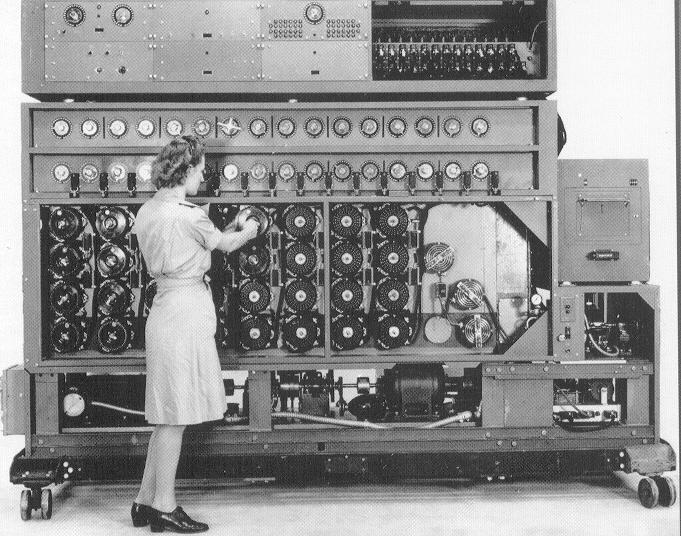
The Nazis used their enigma machines to encrypt all of their secret messages, from weather reports to war strategies. Police cryptanalysts had already made a working bombe: a electromechanical device that can be used to break enigma machines. However, the Polish bombe was not a perfect method, and as Germans perfected their enigma machines, it became increasingly difficult to break their codes. Turing, working with Gordon Welchman, created the Turing-Welchman bombe, which was more efficient and accurate and helped the Allies greatly. They exploited one fundamental weakness in the enigma machine – the fact that no matter what configuration the rotors are in, a letter will never be mapped to itself in the encrypted message (“a” in the normal message will never be “a” in the secret code).

By creating this method for breaking German codes, Turing directly aided the United States in
For more information on how Turing broke the enigma machine: 


A Turing-Welchman Bombe

Other work:
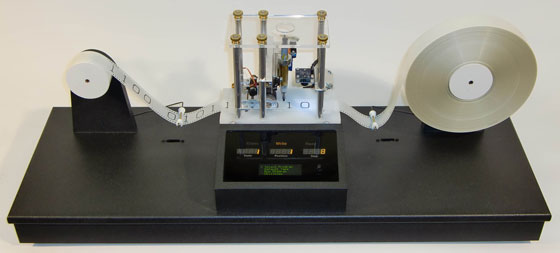
Turing’s work during World War II was helpful to the Allies victory as well as to the field of cryptography. Even beyond this work, Turing was an enormous contributor to the fundamentals of computing: his Turing machine and Turing thesis are still the basis of how engineers think about the limitations of computers. A computer can only perform a certain function if that function can be performed on a Turing machine, pictured here:
Check out more about Turing’s contributions to math, logic, and computer science here: http://www.math.rutgers.edu/courses/436/Honors02/turing.html

Conviction and Death
In 1952, Turing plead guilty to charges of “gross indecency” for being in a relationship with a man. In 1952 in England, homosexual acts were criminal offences. When convicted, he was given a choice of jail time or chemical castration. Turing chose chemical castration. Two years later, Turing committed suicide.
Only in recent years has the despicable treatment of Turing been condemned by the British government. Prime Minister Gordon Brown issued a formal apology to Turing in 2009, but in 2012, the PM David Cameron’s government refused to offer him a governmental pardon. In December 2013, Turing was awarded a royal pardon, which is issued by the queen rather than parliament.
The apology and pardon were issued because people believe that Turing’s amazing life and achievements should be focused on rather than his conviction. However, human rights activists argue that Turing should not be given special treatment and apologized to because of his fame; instead all people similarly convicted should be apologized to because a terrible law infringed on his human rights.

What do you guys think about Turing's conviction? 
The Allies were much more proficient than Germany when it came to code breaking. Do you guys think this played a large role in the outcome of the war or a relatively small one? Also, is it just me or is it really cool that Turing was able to break the Enigma machine with a bombe that could decrypt messages in less than 20 minute?


Sources:
http://mg.co.za/article/2014-01-09-10-things-about-alan-turing
http://www.turing.org.uk/scrapbook/ww2.html
http://www.forbes.com/sites/daviddisalvo/2012/05/27/how-alan-turing-helped-win-wwii-and-was-thanked-with-criminal-prosecution-for-being-gay/
http://www.cnn.com/2013/12/24/world/europe/alan-turing-royal-pardon/

Friday, December 13, 2013

Fascist Italy's Economy & The Depression

World War I had greatly damaged the economy of Italy. Much capital was lost fighting the war, after which Italy received considerably less land than it though it would. Italy was considerably weaker than other European Nations, especially Britain and France. Italy was also considerably behind in industrialization, and was far more into agriculture at the time.'

Benito Mussolini knew very well that the economy of Italy was poor. He wanted to do two things: attack the power of trade unions to control workers and increase productivity, and increase the birthrate. For economic prosperity, Mussolini introduced the "battles": The Battle for Land, Lira, and Grain.

The Battle for Land was to clear the marshes make it useable for farming, amongst other things, such as new roads. The Pontine Marshes were amongst the lands that were reclaimed for infrastructure. Many see this specific campaign as a success.


Mussolini on a Tractor in the Marshes

The Battle for Lira was for restoring the value of the Italian currency from the past days. The lira as currency was very weak, and Mussolini had to fix it in order for Italy to become a world power. He inflated the value of the lira, making exports expensive in the process. This "battle" was overall a failure, resulting in unemployment when many firms and shops couldn't sell products. Italy was hard hit during the Great Depression, with many industries failing after a bailout from the banks that was the result of worthless purchasing assets. However, since Italy was still heavily agriculturally-based, its economy didn't suffer as much as did the economies of more heavily-industrialized European nations such as Great Britain.

The Battle for Grain was to replace cheaper vegetables and fruits with more expensive grain production. This turned out to be a failure as well, since Italy wasn't industrialized enough to efficiently and productively grow and harvest grain in large amounts.

Source:


The New Deal

The New Deal was a series of domestic programs enacted by the United States between 1933 and 1936. These were programs put in place by Congress and President Roosevelt, for the alleviation of the Great Depression. The programs were modeled after Roosevelt's 3 R's: Relief (for the unemployed and poor), Recovery (of the economy to normal levels), and Reform (of the financial system to prevent another depression). It was a political realignment that made the Democrats the majority. From this, the republicans were split, and the Conservatives entirely opposed the New Deal, for they thought of it as an enemy of business and growth, while liberals somewhat accepted it as they wanted to make revisions to make it more efficient. From this, the New Deal Coalition was formed.

Upon the Democratic nomination for president in 1932, Franklin Roosevelt promised a new deal to the American people, and said:

"Throughout the nation men and women, forgotten in the political philosophy of the Government, look to us here for guidance and for more equitable opportunity to share in the distribution of national wealth... I pledge myself to a new deal for the American people. This is more than a political campaign. It is a call to arms."

 He wants to greatly improve upon the American economy, obviously because they are in the midst of the Great Depression. He says he wants to share the national wealth in this New Deal.

The New Deal faced some vocal conservative opposition. The first organized opposition in 1934 came from the American Liberty League, which was led by conservative Democrats such as John W. Davis and Al Smith (presidential candidates). There was also a large but loosely affiliated group of New Deal opponents, who were commonly known as the Old Right. This group consisted of politicians, intellectuals, writers, and newspaper editors of various philosophical persuasions such as classical liberals and conservatives, both Democrats and Republicans.

 The New Deal represented a significant shift in politics and domestic policy. It mainly led to greatly increased federal regulation of the economy. It was also the beginning of many complex social programs and the growing power of labor unions. The effects of the New Deal has many viewpoints and angles to argue, in my opinion, I think the New Deal was a major stepping stone for America to get back on track during this horrid time period.

Source:  http://en.wikipedia.org/wiki/New_Deal

The "Monkey Trial"

During the 1920s, many social patterns were disrupted, often with passionate backlash. Traditionalists were worried that core values were ending. Modernist intellectuals often experimented with new methods and styles, while revivalism of the old ways developed, specifically in the South. Journalists knew that the traditionalists and modernists would soon clash spectacularly over something, and they finally found that great showdown, during the summer of 1925 in Dayton, Tennessee.

Dayton was a small town with a dropping population, from 3,000 people in the 1890s to 1,800 people in 1925. The people of Dayton, including school superintendent Walter White, wanted publicity brought to their town to increase their population. When William Jennings Bryan, the former populist presidential candidate in the 1890s, went on a Fundamentalist "crusade" to ban teaching evolution from schools, George Rappalyea, a modern Methodist and Dayton resident, approached 24-year old general science high school teacher John Scopes in Fred Robinson's drugstore. Rappalyea, with the town's desire for publicity in mind, asked Scopes about his evolutionist teachings from the Hunter's Civic Biology textbook, which was state-approved. Rappalyea told Scopes that his teachings were against the law, and asked if Scopes were willing to stand trial for a "test case." Scopes consented.

Rappalyea set out on finding people to head the defense team. He requested that famous science fiction writer H. G. Wells head the defense, but Wells turned down the offer. When William Jennings Bryan joined the prosecution team, 70-year old agnostic Clarence Darrow jumped to join the defense. John Neal, Arthur Garfield Hays, and Dudley Field Malone joined the defense as well, while Bryan Jr (Bryan's son), Ben B. McKenzie and A. T. Stewart joined the prosecution. Darrow and Bryan are the most remembered people in the case, but Hays and Stewart were equally important in the case. The judge was Judge Raulston, a flamboyant conservative Christian.

During the opening of the trial in July of 1925, the town had a festive air, with lemonade stands, banners, and chimpanzees brought into town as sideshows. Almost a thousand spectators showed up in the courthouse. In addition, live radio broadcast was set up.

The overall goal of the defense was not to acquit John Scopes, but to bring the case into the higher courts, ultimately the Supreme Court, in order to make anti-evolution laws unconstitutional

The State of Tennessee v. John Thomas Scopes started off with opening statements portraying the struggle as good vs evil or truth vs ignorance. Bryan claimed that "if evolution wins, Christianity goes." Darrow argued, "Scopes isn't on trial; civilization is on trial." The prosecution, Darrow contended, was "opening the doors for a reign of bigotry equal to anything in the Middle Ages." To the gasps of spectators, Darrow said Bryan was responsible for the "foolish, mischievous and wicked act." Darrow said that the anti-evolution law made the Bible "the yardstick to measure every man's intellect, to measure every man's intelligence, to measure every man's learning." Darrow then cross-examined--gently, though with obvious sarcasm--the students, asking freshman Howard Morgan: "Well, did he tell you anything else that was wicked?" "No, not that I can remember," Howard answered.

 That Thursday, Johns Hopkins zoologist Dr. Maynard Metacalf countered Bryan with a speech that detailed evolution. The speech was met with standing ovation, but the judged ruled it as inadmissible, which angered Darrow. The case had to be moved out into the lawn, as there was fear that the packed courtroom floor was going to collapse. The crowd had swelled to 5,000.

Darrow continued the defense, using 8 scientists and 4 religious experts to testify, with an intent to educate the nation on evolution. On the 7th day of the trial, Hays called on Bryan to be an expert on the Bible, which Bryan accepted. Darrow asked Bryan if he took everything in the Bible literally. Bryan was asked about a whale swallowing Jonah, Joshua making the sun stand still, Noah and the great flood, the temptation of Adam in the garden of Eden, and the creation according to Genesis. After initially contending that "everything in the Bible should be accepted as it is given there," Bryan finally conceded that the words of the Bible should not always be taken literally. In response to Darrow's relentless questions as to whether the six days of creation, as described in Genesis, were twenty-four hour days, Bryan said "My impression is that they were periods." Bryan accused Darrow of attempting to "slur at the Bible." He said that he would continue to answer Darrow's impertinent questions because "I want the world to know that this man, who does not believe in God, is trying to use a court in Tennessee--." Darrow interrupted his witness by saying, "I object to your statement" and to "your fool ideas that no intelligent Christian on earth believes." The judge then ordered the court adjourned.

Bryan was reported by the press as failure during his performance in the Darrow interrogation. In their eyes, Bryan had lost.

Near the end of the trial, Darrows requested the verdict to be guilty to move the case up into higher courts. The judge complied, fining Scopes $100. This case was finally brought to the Supreme Court in Epperson vs. Arkansas, but not for another 43 years.

Source:
http://law2.umkc.edu/faculty/projects/ftrials/scopes/evolut.htm


History Repeats Itself: The Great Depression and The Great Recession

Overview In the 1930's, the United States witnessed the greatest economic downturn that would prove to have a negative impact on the government, people, and morale of the nation. This nation experienced a very similar crash in late 2008, which some now call the Great Recession. Many wonder how these events in history even occur in the first place and what attributed to it. Through events in history, we can observe a myriad of different causes that resulted in the Great Depression and Recession, but one major concept stands out and that’s the idea of credit and failure to pay off loans.

Great Depression: Stock Market Mistakes


Both failures in the economy can be credited back to the decisions of the Federal Government and its citizens. During the 1920’s, banks were giving out loans freely to people because of the great state of the nation economically. Interest rates were kept low during the Roaring Twenties and because of the great economic times people were constantly using credit to buy materials and items they did not really have the money to spend. People started using this idea of loans and margins in the stock market, where they would take out a loan and pay it off through the profit they made in the marketplace. Essentially, they were buying stock without physical money in their pockets and rather on the guarantee that the stock would rise in value and gain them enough to pay back both the loan and obtain a profit. However, in 1929 the Federal Reserve decided to drastically increase interest rates. This created a constriction on investments and when the market crashed, people now did not have the money to pay off the massive loss and loans they owed. Banks were forced to foreclose homes and repossess from the people who owed money, but often times citizens would not have anything of equivalent value. This in turn caused the banks to go bankrupt and a downward spiral in the economy.

Great Recession: Housing Bubble


Many people can observe the same concept and build up in the Great Recession of 2008 that attributed to the crash in our generation. The changed variable in our crash was in the housing market, but the concept of the government and banks allowing loans to be given out to people to spend on items they could not necessarily afford is a repeat of history. During the early 2000’s, the housing market was in a rapid increase and many people were buying houses they could not afford because they believed the houses would only continue to rise in value. The idea here is people would live in a house for a couple years and later sell it a higher value in order to pay off the loans and gain profit. This concept was the identical mentality of Americans who played the stock market in the 1920’s. As history always repeats itself, when the housing bubble popped, many people panicked and foreclosed their homes. Banks and hedge funds who invested in the housing market now suffered catastrophic losses. Ultimately, a $700 billion bailout occurred in order to compensate for the myriad of bankruptcies that resulted from the crash. The country’s economic state was once again plummeting down and would continue until 2010.

Conclusion


The Great Depression and the irrational actions taken by Americans should have been a clear warning to future generations to never commit the same actions. However, it is evident through the Great Recession of our time that history does indeed repeat itself. Failure to learn from mistakes only creates future problems and America experiencing two similar events occur should be a red flag that people take note of in order to prevent this situation from ever happening again.


Source: http://www.fee.org/the_freeman/detail/comparing-the-great-depression-to-the-great-recession#axzz2nLw5IIHV

The Struggling Life of the American People


Trying to imagine living life during the Great Depression is not even fathomable to me. The technological lifestyle of smartphones and computers that people have today may seem like heaven to the people of the 1930’s. The amount of economic struggle and social stress experienced by the average person during these times was terrible. Let’s take a look at how the Great Depression impacted the people of our nation.

There was a constant struggle to uphold a family during this time. From 1929 to 1933, the child birth rate dropped 15%. More children meant more money going out of adult’s pockets, so the Great Depression created a sense of “downsizing” on the family size. With that, people were also getting married less; it saw a decrease of 22% during the same time period. Many Americans were now experiencing new situations they were not accustomed to such as poverty and even homelessness. Whether you were middle class, working class, urban, or rural, the Great Depression devastated and affected you either way. Unemployment was an all time high at nearly 25% employed and thus many lost their main source of income. For those lucky enough to have jobs during this time, their hours and pay were still reduced. During this period, more than half of the farmers in the nation made less than $1000 a year. Factory workers earned $1449 a year and barely had enough for food and home expenses. Prices increased too rapidly and items were not affordable by the average American income. This ultimately resulted in strikes that would end via police brutality. Overall, there was no longer this sense of security and enjoyment that was booming during the 1920’s and everyone, whatever social or ethnic group you belonged, proved to be affected by the Great Depression.


Source:

http://depts.washington.edu/depress/everyday_life.shtml

The Interregnum: Roosevelt vs. Hoover


Today I wanted to take a look at the differing views of President Hoover and President Franklin D. Roosevelt and how their incongruity contributed to the failure of the nation to stabilize and materialize during the times of the Great Depression.

Overview:

The Interregnum was a 4 month gap between the transition from President Hoover, who was exiting office, and to President Franklin D. Roosevelt, the new incoming president. Due to the 20th amendment, the inauguration date was moved to January 20th. It was time where there was a lack of direction and leadership during a struggling period since both presidents had little influence; people no longer cared about a president leaving and the other one was not in officially presidency to hold power. This period was one of the lowest economic points of the Great Depression. The differing economic and political policies between Hoover and Roosevelt ultimately created the conflict that would further worsen the economic situation.

Different Views in Economic and Foreign Policies

In terms of foreign relations, President Hoover believed in eliminating all foreign debts in order to entice other nations to export American products. He believed that other nations would feel a sense of indebtedness to our country and buy from the American market. On the other hand, Roosevelt thought that foreign trade was unnecessary and wanted to focus on creating a national economy. He believed that the Great Depression occurred through domestic means, so it could be cured through domestic ways as well. Along with that, President Hoover desired to uphold the gold standard, but Roosevelt favored silver and failed to acknowledge Hoover’s plan. This created a currency devaluation at the worst possible time and further decrease in the economy.  

Political Views

In the eyes of many, President Roosevelt was seen to a have dictator like style to him. He had a firm grip on the country during these times and executed his power in unorthodox ways. FDR arguably used much of his powers for good to fix the recession. However, when the country was weak and in need he took advantage of his power to further his party’s ideas. Instances such as dissolving the Gold Standard, Security Regulations, and Public Works are examples of changes Roosevelt made with his executive decision. On the other hand, President Hoover was seen more as a progressive and reformer. He believed that the federal government should place a system to regulate the economy instead of directly intervening. In addition, he pursued to aid farmers and the agricultural market. In 1930, Hoover signed the Smoot-Hawley Tariff Act, which would raise the tariffs on imports and ultimately help protect farmers.

Conclusion

Many people blame Hoover for much of the Great Depression because of his inability to execute an effective plan and system to carry America out of the Great Depression, but a lot of it can accredited to Roosevelt’s initial complacency and stubbornness as well. The adversity between the two and the lack of cooperation as a whole during the Interregnum is the main reason for the country’s failure to recover immediately. The country may have been able to recover from it’s “wounds” much quicker if there was a better compromise between the two presidents of the time.
Sources:
http://en.wikipedia.org/wiki/Franklin_D._Roosevelt
http://en.wikipedia.org/wiki/Herbert_Hoover